
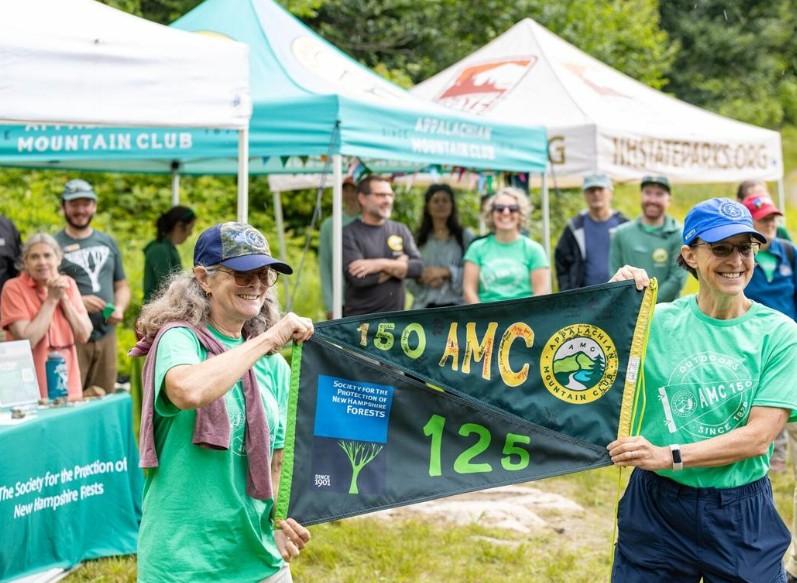
AMC150 hike relay leaders Deb Minor, left, and Laurie Schieve hold up pennants at the anniversary event in July.
On July 21, The Society for the Protection of NH Forests and The Appalachian Mountain Club celebrated two milestone anniversaries: 150 years since the founding of the AMC and 125 years since the founding of The Forest Society.
Along with North Country friends and longtime agency partners, including the NH Division of Parks and Recreation and the White Mountain National Forest, the special event was held at the base-station of the Cannon Mountain Aerial Tram in Franconia Notch — the exact former location of the historic Profile House.
Profile House
In 1852, Richard Taft and his company, the Flume and Franconia Hotel Company, bought the former Lafayette House at the north end of Franconia Notch. Construction began on the first “Profile House,” and it opened in 1853. This first iteration of The Profile House was renovated in 1868 and completely rebuilt in 1906. It lasted 17 more years serving hundreds of wealthy guests in opulent fashion.
According to The Upper Pemigewasset Historical Society, The Profile House was a self-sufficient community that operated a large farm with a herd of dairy cows and a greenhouse. There was a power plant, a boathouse with a steam launch on Echo Lake, dormitories for workers, a bowling alley, a post office and telegraph office, barbershop, billiard hall, music room, souvenir shops, a golf course and even a fish hatchery for raising trout to stock the small trout pond. The hotel owned thousands of acres in Franconia Notch, including the Old Man of the Mountain, The Basin, The Pool and The Flume. A mineral spring house provided water for guests.
Rustic recreation pursuits included hiking, tennis, badminton, croquet, fishing, boating and horseback riding, according to the society’s website, uphsnh.org/the-profile-house. The horse stable could accommodate up to 350 horses and carriage sheds housed a wide variety of wagons and horse-drawn coaches. In 1872, hotel owners built a narrow-gauge railroad from Bethlehem to eliminate a bumpy, dusty stagecoach ride from the north. The 9.5-mile railroad had two engines named for each lake in the Notch: Profile and Echo. In 1883, rail service was opened from the south from Plymouth to North Woodstock and guests finished their journey via stagecoach. The railroad continued operating up until 1921 when declining hotel business and the arrival of private automobiles forced closure of rail service.
The fire
By the summer of 1923, The Profile House Hotel had been recently purchased from longtime owner Colonel Greenleaf and had been renovated by new hotel operators, the Abbott Family of Bethlehem.
This year marks 103 years since a wind-whipped fire destroyed the entire Profile House complex, including private cottages, at the peak of the summer season on Aug. 2, 1923.
Having started in the attic sometime after noon, smoke was first spotted by tennis players on the hotel courts. The blaze subsequently incinerated 26 buildings — some connected by wooden canopies over walkways in less than four hours. The resort was packed with summer guests who all escaped safely, many helping to remove furnishings from common areas and placed on surrounding lawns and tennis courts.
The sprawling hotel complex was a total loss. At the time, the Profile House could accommodate 500 guests and was the most luxurious hotel on the western side of the White Mountains. Today, the parking lot at the Cannon Mountain Aerial Tram covers the exact site where Profile House stood for 70 years.
Phoenix from the ashes
By 1924, a year after the fire, the Abbott family offered to sell a total of 5,000 acres along 7 miles on both sides of the Daniel Webster Highway in the heart of Franconia Notch to the highest bidder. The Society for the Protection of NH Forests launched a campaign in a race against a firm deadline of June 1928. The price was steep for the era: $400,000. The Forest Society’s seasoned campaigner for protection of mountain landscapes including Sunapee, Lost River, Monadnock, Kearsarge and the White Mountains, was already a legend: Philip Ayres. In 1925, Ayres persuaded Gov. John Winant to ask for half: $200,000 from the New Hampshire Legislature. The request was unanimously approved. A century ago in 1926, the race was on to raise the balance privately before the June 1928 deadline.
Franconia Notch was proposed as a permanent memorial dedicated “To the men and women of New Hampshire who served the nation in times of war.” The Manchester Union Leader headline at the time read: “SEND IN YOUR DOLLARS! BUY AS MANY TREES AS YOUR PATRIOTISM ALLOWS.”
Forest Society Treasurer James J. Storrow personally pledged a gift of $100,000. The NH Federation of Women’s Clubs took up the challenge, setting quotas for each chapter, successfully raising $65,000. Donors then “bought” trees for a dollar apiece. With contributions as small as a nickel, school children alone raised more than $1,000. College alumni associations made memorial contributions to honor fallen soldiers killed during World War I.
Fifteen-thousand individuals and institutions from across the nation and the world ultimately donated $200,000 to meet the June 1928 deadline.
On Sept. 15, 1928, the property was dedicated as the Franconia Notch Forest Reservation and Memorial Park. Iconic locations have become synonymous with Franconia Notch State Park, including The Flume, The Pool, Lafayette Place, The Basin, Profile Lake, The Old Man of the Mountain, Cannon Cliff and Echo Lake. A decade later, in 1938, another cataclysm would transform The Notch.
Well, all except for The Flume. The state did not feel capable of running the popular tourist attraction. In 1928, Gov. Huntley Spaulding essentially told the Forest Society: If you wanted this done, you run it. The Forest Society continued to operate The Flume at a profit for 20 years until 1948 when the N.H. Department of Parks and Recreation began management.
Halfway through the Forest Society tenure at The Flume, the 1938 hurricane blew down an estimated 5 billion board feet of timber statewide. Salvage logging operations resulted in milling 400 million board feet of white pine timber from 1939 to 1941 — just prior to the outset of World War II. Hiking trails across the White Mountain National Forest remained closed for several summers due to concern for elevated forest fire danger.
One famous 180-foot-tall white pine overlooking The Pool at The Flume, “The Sentinel Pine,” toppled in the ’38 hurricane. A Forest Society crew hoisted an 80-foot section of the massive trunk 100 feet above the upper Pemigewasset River to serve as the central support beam for the “Sentinel Pine Covered Bridge” at The Flume. The bridge is a photogenic icon, a rustic shelter covered bridge for pedestrian traffic walking the loop at The Flume.
Franconia Notch today
Today, dramatic scenic peaks of Cannon Mountain and the Franconia Ridge frame the floor of Franconia Notch, attracting summer and fall foliage visitors. Recreational hikers, rock climbers, anglers and winter skiers access trailheads and parking areas from the scenic two-lane parkway through the floor of The Notch.
The parkway remains the only two-lane section of Interstate Highway in the nation because the highway construction itself was a 30-year legal battle ending in a compromise with conservation alternatives advocated by The Forest Society and The Appalachian Mountain Club, among others.
The lessons of the conservation campaigns to protect the natural, cultural and scenic resources of Franconia Notch included public engagement, fundraising and building alliances between organizations to leverage state leaders and community stakeholders.
Yet ultimately, the most famous Franconia Notch attraction — “The Old Man of the Mountain” — would not be saved from rain, ice and gravity.
That’s another lesson we all learn eventually: Nature bats last; gravity always wins.