
- Tags:
- Forest Journal
March can be a month of extremes in New Hampshire, as the familiar tagline “in like a lion, out like a lamb” reminds us. It’s the beginning of the great annual thaw, and March can deliver mild, sunny days that take us down to shirtsleeves, or biting cold and impossibly deep snow accumulations.
According to The White Mountains Almanac, 68 years of temperature records in North Conway have documented a record high for the month of 85⁰ F, and a low of -22⁰ F.
Unsurprisingly, the possibility of a 107 degree swing in temperature for March is greater than any other month of the year.
Although I have fond memories on both ends of the meteorological spectrum, my favorite March moments tend toward the warmer side. On the first truly balmy day in March, I love to sit out in a beach chair on my deck, anemic face tilted up towards the sun, just listening to the outside world melt and doing my best impression of a solar panel.
The first order of business in this March porch fantasy is usually to clear the roofline over our deck of all the icicles with murderous intentions. Since the roof here is covering a greenhouse room, our icicles grow to incredible sizes and shapes most years, piquing my curiosity enough to do some research into how they develop such interesting proportions.
Icicles form when melting snow or ice drips repeatedly in the same spot. If the air is cold enough, a water droplet can freeze just before it actually drops, beginning an icicle.
As more water droplets follow, the temperature at the base of the icicle (where the sun hits the roofline, or perhaps a rock ledge in the natural environment) is warmer than that near the tip — so each new drop creates a thin film of water as it slides down the icicle, getting supercooled as it moves toward the tip.
Some of that water will refreeze as it slides down, making the icicle just a bit thicker and a bit longer, drip by drip.
Did you know that there is an entire laboratory at the University of Toronto dedicated to icicle science? They have grown hundreds of icicles under tightly controlled laboratory conditions in a beer-fridge shaped contraption they call the “icicle machine” and documented each result meticulously to understand how different icicle formations develop.
It turns out the perfect icicle — a single, smooth, symmetrical spike (the researchers call this a platonic icicle) isn’t that easy to grow. There has to be some gentle air movement for perfect icicles to form — not completely still nor too breezy. The water used also has to be extremely clean with no impurities — platonic icicles were achieved only with distilled water in the lab; Toronto tap water wasn’t even close.
Even the tiniest amounts of dissolved salts, minerals or even dirt particles will cause an icicle to form ridges; add more impurities and those ridges become more pronounced and sometimes form additional tips resulting in craggy, misshapen icicles (like the ones on my porch, hmm). You’re welcome, because now you know which icicles are safer for your kids to lick!
Icicle ridges are interesting because they all have nearly the same wavelength — about 1 centimeter between ridge crests — regardless of the concentration of salts and minerals in the water that formed them.
At first, the Icicle Lab scientists thought this invariability might be because the surface tension of water remains constant regardless of the amount of dissolved salt. Then they added a surfactant (like a soap or oil) to the icicle water, which did change the surface tension, and … nope, ridges were still 1 cm apart.
So they haven’t solved the mystery of icicle ridge wavelength constancy yet, but still, it makes me happy just to know that someone out there is working on it.
Now, getting back to my sunny porch daydream. The best way to fully enjoy sitting in the March sunshine is with the perfect seasonal beverage, and I highly recommend one called the sap and soda.
Besides icicles, the other objects doing a lot of dripping this month are maple taps, and this cocktail or mocktail is made with pure New Hampshire maple syrup.
Since March is Maple Month in New Hampshire, finding a jug of local syrup is easy with many maple producers opening their sugarhouses to the public on weekends.
If you’d like a deep-dive on how syrup is made, I suggest heading to the Maple Experience at The Rocks in Bethlehem (nhmapleexperience.com), where you can try your hand at tapping trees and learn about the history of maple production, too.
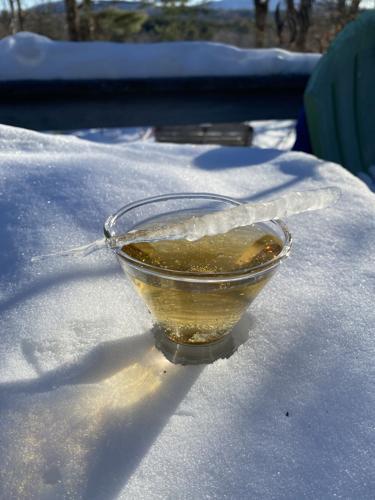
To make a sap and soda, find your fanciest glass and combine a generous tablespoon of maple syrup (the darker the better here) with eight to 12 ounces of club soda. A shot of bourbon or vodka is fine too, if you’re so inclined. Sweeten to taste by adding more syrup, and for best results, stir gently with — you guessed it — an icicle!