
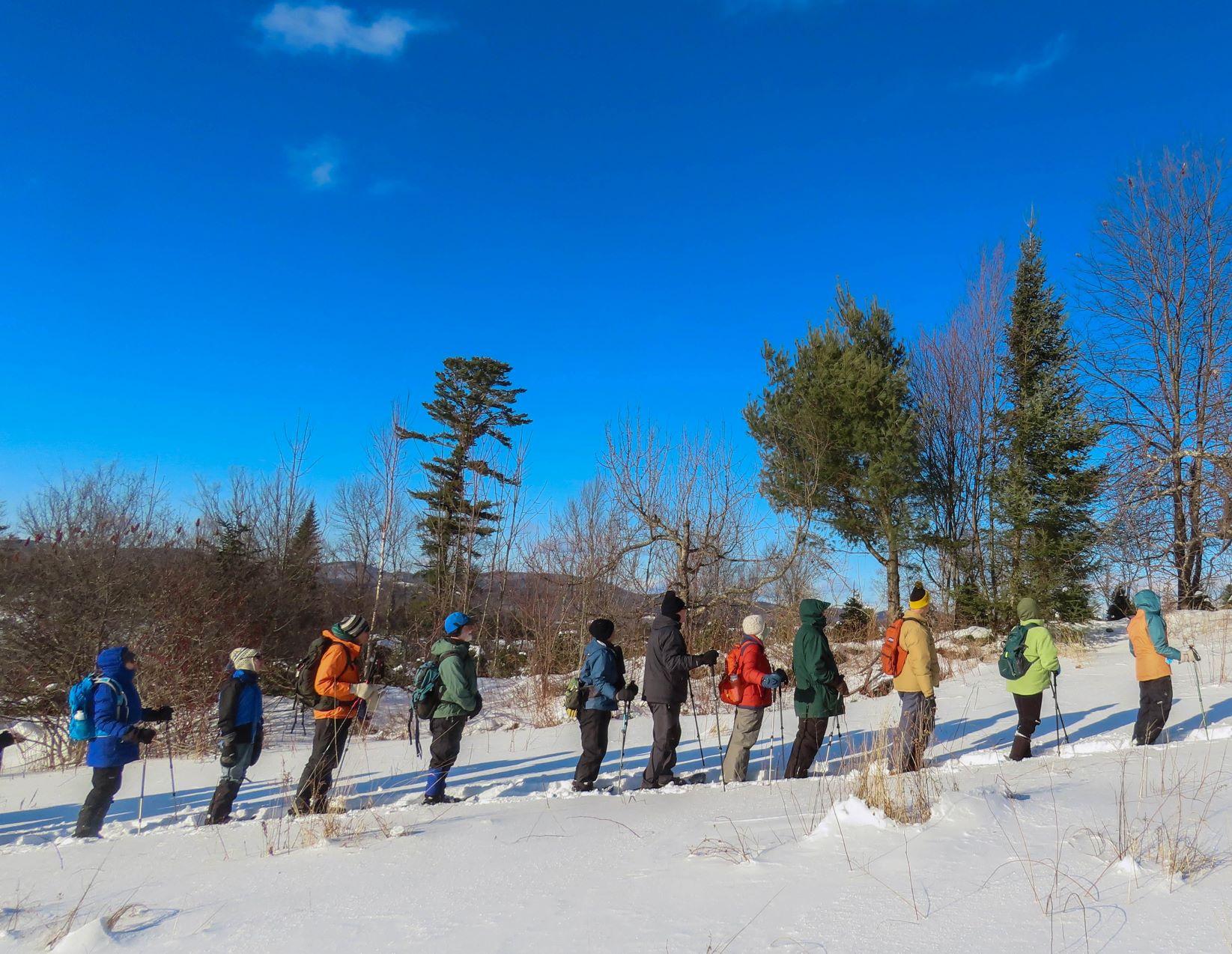
Snowshoers enjoy a sunny day at The Rocks in Bethlehem. Trails at the site are open daily from dusk until dawn; photo by Nigel Manley.
Winter arrives differently in the North Country. It announces itself not just with cold, but with quiet — snow softening the edges of roads, trees holding their breath, trails reappearing as familiar lines beneath fresh powder.
Having been fortunate enough to live both along New Hampshire’s Seacoast and, in more recent years, here in the North Country, I’ve come to appreciate how distinct — and deeply connected — these landscapes are.
Over that time, I volunteered with the Forest Society and now work here full time, but first and foremost I’ve experienced these places simply as someone who loves to be outside.
On a bluebird morning, with skis or snowshoes strapped on and breath hanging in the air, it’s easy to feel grateful for this area of New Hampshire I get to call home.
That gratitude deepens when you pause to consider how much of this winter experience — gliding through forests, crossing open ridgelines, tracing old logging roads now reborn as trails — exists because people before us thought ahead.
At the turn of the 20th century, the headwaters of the White Mountains were heavily logged, rivers choked with debris, and hillsides stripped bare. In 1901, a small group of New Hampshire citizens came together to form the Forest Society in response, concerned not only about scenery, but about water, soil, and what future generations would inherit.
After years of intense advocacy by the Forest Society and other conservation groups, Congress passed the Weeks Act in 1910. The legislation became law on March 1, 1911, when it was signed by President William Howard Taft. Named for John Weeks, a Massachusetts congressman originally from Lancaster, New Hampshire, the law authorized the federal government to purchase private land to protect rivers and watersheds essential to interstate commerce.
That foresight led directly to the establishment of the White Mountain National Forest and, ultimately, to the creation of more than 40 national forests east of the Mississippi River.
Today, the White Mountain National Forest spans more than 800,000 acres — forming the snowy backbone of so many winter days spent skiing, snowshoeing and exploring.
Franconia Notch offers another powerful example of what shared foresight can achieve.
After the Profile House burned on Aug. 3, 1923, its owners — the Abbott family — did not immediately rebuild. Several years later, in the mid-1920s, they proposed selling roughly 6,000 acres in Franconia Notch, including iconic places such as the Old Man of the Mountain, the Flume, the Basin, two mountain lakes, and 7 miles of land along both sides of what was then known as the Daniel Webster Highway — the old Route 3 through the Notch, long before the construction of Interstate 93.
By 1927, the threat of private sale galvanized action. Philip Ayres persuaded Gov. John Winant to seek state support, and the New Hampshire Legislature unanimously approved funding for half of the $400,000 purchase price.
That left a daunting task: raising the remaining $200,000 by a firm deadline of June 1928. What followed was an extraordinary public response.
The Federated Women’s Clubs of New Hampshire raised a significant share. Colleges and universities contributed funds to memorialize World War I veterans. Schoolchildren sent in nickels and pennies. The Forest Society famously “sold” trees by subscription at one dollar apiece.
In just six months, the full amount was raised, and Franconia Notch State Park was dedicated in September 1928. The Forest Society retained ownership of 913 acres, including the Flume, and operated the park for the next 20 years.
These stories matter not because they belong to any single organization, but because they remind us that today’s New Hampshire did not come to be by chance. The forests, farms and open spaces we enjoy — especially in winter, when their value feels both practical and profound — exist thanks to ongoing care and cooperation by legacy conservation groups and committed partners across the state.
That same spirit of collaboration shaped the statewide Open Space Study released last year, a joint effort among The Nature Conservancy, New Hampshire Association of Conservation Commissions, New Hampshire Audubon, New Hampshire Land Trust Coalition, New Hampshire Timberland Owners Association, Southeast Land Trust of New Hampshire, the Society for the Protection of New Hampshire Forests and the Statewide Program of Action to Conserve our Environment.
Together, these partners examined how conserved lands support not only wildlife and water, but the health and wellbeing of people and communities.
Forestland, farms and open space are more than an attractive green backdrop for outdoor recreation. Access to trails and protected lands supports mental wellness, lowers stress and promotes positive emotional wellbeing.
Time outdoors has been shown to reduce stress hormone levels and support healing. It’s no coincidence that quality-of-life rankings consistently cite New Hampshire’s natural environment as a key draw for residents and visitors alike, with outdoor recreation supporting tens of thousands of jobs statewide.
As we begin a new year, winter invites us to slow down and reflect. Whether it’s a quiet snowshoe loop at dusk, a long ski through familiar woods, or simply watching snow settle into spruce branches, these moments offer restoration — and perspective. They remind us that foresight is not just something our predecessors practiced; it’s something we are called to carry forward.
This winter, may we meet the season with gratitude: for the snow under our skis, the forests standing strong and the enduring legacy of people who believed that New Hampshire was worth caring for — then, now, and into the future.