
When it comes to New Hampshire’s forests, Bambi has a lot to answer for.
“If you’re trying to manage and grow healthy, resilient forests, (deer) are a problem,” said Wendy Weisiger, managing forester for the Society for the Protection of New Hampshire Forests. “They’re actually changing the composition of our forests in many places.”
As anybody who has tried to grow arborvitae in their yard knows, white-tailed deer are voracious browsers. In Northeast forests, they will eat all the saplings of oak, sugar maple, birch and other desirable hardwoods that grow up in areas where sunlight reaches the ground, such as after a timber harvest. That leaves behind less biodiversity and more openings for invasive plant species. It’s a major problem.
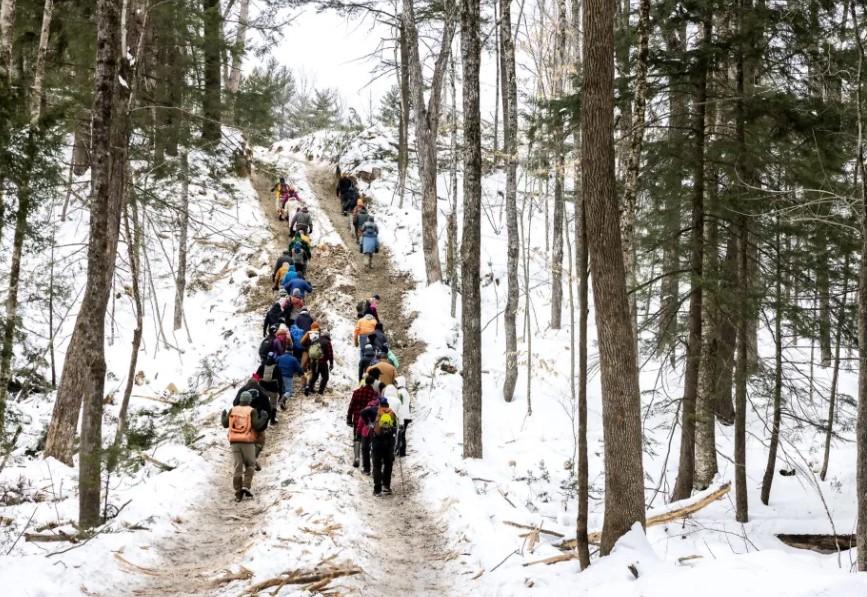
A tour last weekend of a logging site in Henniker was part of efforts to control this cute but destructive pest using “slash,” the debris such as treetops, branches and small trees that are left over after marketable lumber is removed. Studies in other parts of the country have shown that slash can be piled up to create walls that will keep out deer for a half-dozen years, enough to let hardwoods get established to withstand the four-hoofed invaders.
It’s one thing to use slash as a deer deterrent but another thing to know exactly how to do it. Saturday’s tour brought attention to two test plots, covering about seven acres, to help determine best practices.
At one site, loggers built a slash wall all around the protected area, creating what Weisiger called “a big donut.” The wall is huge — 8 feet high and 10 feet wide — because deer are really good jumpers, as anybody knows who has installed a deer fence to protect their garden and then lost their garden.
On the other test site, loggers spread the slash over the entire ground to a depth of about 4 feet, basically making it so annoying to walk that deer would stay away. That site has a secondary advance of providing more cover for small mammals and birds.
Game cameras were installed to see how wildlife respond to each. The Forest Society will examine regeneration over coming years.
The idea is not just to see what works better but to get data on which is more feasible for a working logger to guide landowners who want to reduce deer damage.
“What does it cost, how long does it take, how viable is it for other landowners to do,” said Weisiger. “We want to provide advice and information to others who want to try to do it.”
There’s a bigger story here because white-tailed deer are an example of what are sometimes called “rat species,” although the technical term “synanthrope” sounds more professional. These are species of wildlife that don’t mind being around people — they thrive even as we destroy their natural habitat and drive away their competitors.
Examples include rats, pigeons, coyotes and raccoons but deer are right up there. With their natural predators largely gone, deer numbers have soared throughout the eastern U.S. Attempts to control populations through hunting or birth control have failed, partly because society is reluctant to go all-out in a War On Bambi.
Rat species are a sobering reminder that you can’t predict what will happen when we alter nature. Cut deer killing off the forests we love is a perfect example, although their role helping spread Lyme disease through ticks is pretty potent, too.
The answer, of course, is to stop messing around with nature.
Yeah — like that’s going to happen.